Portfolio
Featured AI Systems
NorthStar moves from raw learner data to a decision a leader can act on, and every AI answer is checked against its sources before you see it.
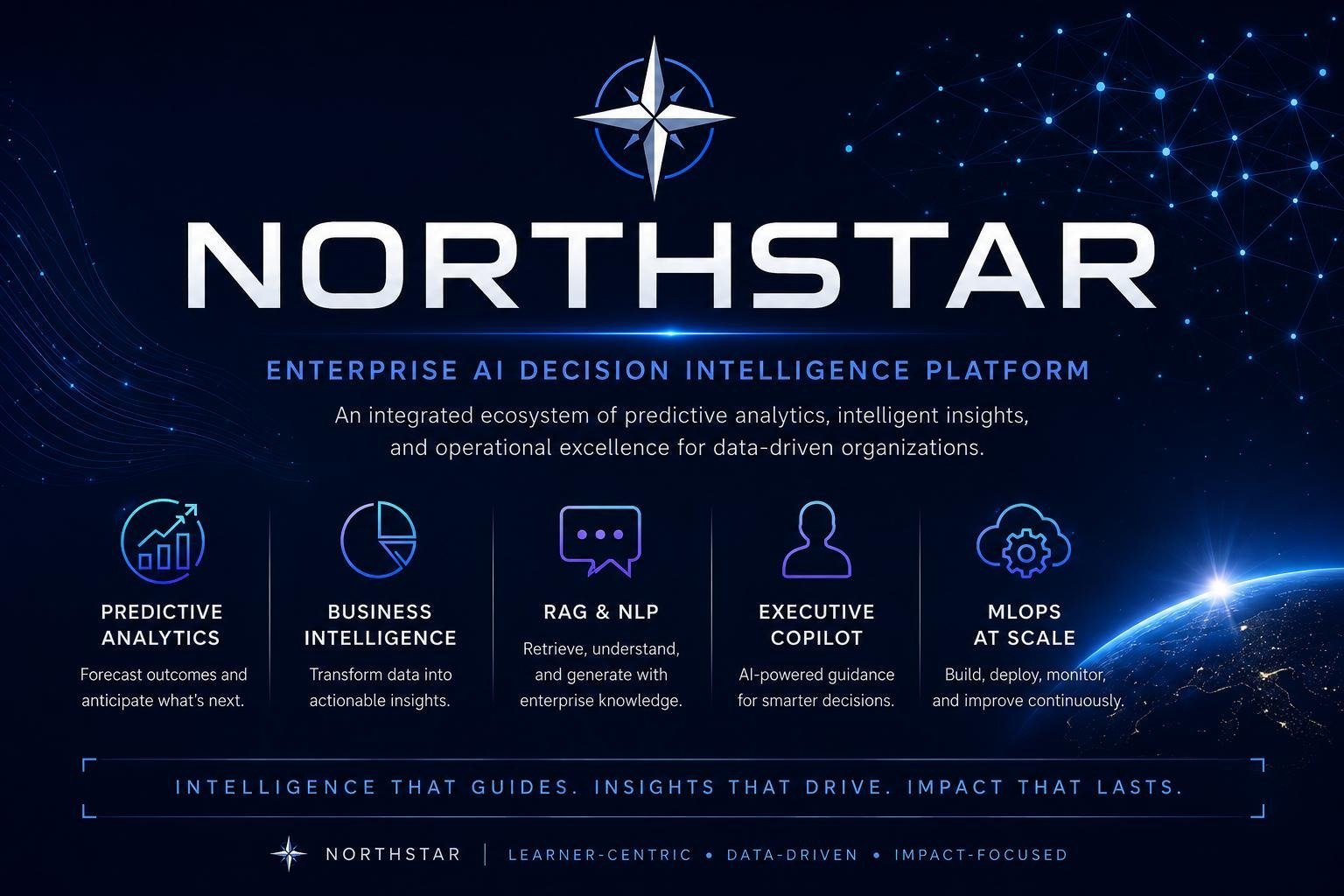
Enterprise AI Decision Intelligence Platform
Predictive Analytics • Executive BI • Grounded RAG • Agentic AI • Microsoft Azure AI • MLOps
Curiosity becomes architecture. NorthStar moves from raw learner data to a decision a leader can act on, and every AI answer it gives is checked against its sources before you see it. Built, measured, and shipped, not just prototyped.
AI Intelligence Layer
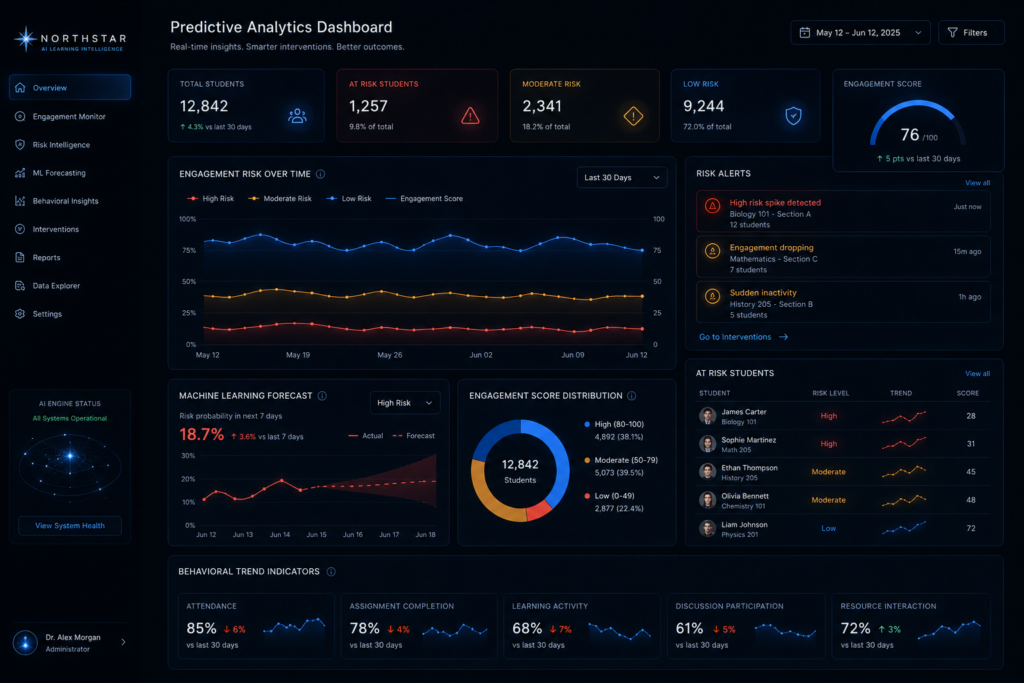
Five AI capabilities on one platform, on top of an executive dashboard that turns at-risk predictions and KPIs into prioritised recommendations.
RAG Knowledge Assistant
Grounded answers, or an honest “I don’t know”.
Ask in plain language and get an answer with its sources cited. Every answer is checked against those sources before it’s shown; if it can’t be verified, you see the source passages instead of a guess.
Agentic Intervention Copilot
Plan, investigate, approve
An agent that plans its own investigation, finds who’s at risk using the real models, and proposes the fix — but nothing happens until a person approves it. (Built and tested; code on GitHub.)
Executive Copilot
Briefings grounded in live metrics
Turns the dashboard into a clear next action for leadership: on-demand briefings written only from the platform’s live numbers, never invented ones.
MLOps Foundation
Built to run, not to sit in a notebook
Docker, a GitHub Actions CI pipeline with automated tests, a model registry that tracks versions and usage, and evaluation gates that catch quality regressions before they ship.
Knowledge Agent
Documents and data, in one answer
Built on Microsoft Agent Framework and Azure AI Foundry, it answers from the knowledge base with cited sources and reads exact numbers from the learner data lake, through a read-only connection that can never change the data. Ask “How many learners in Berlin are at risk?” and it queries the data rather than guessing.
Three guardrails between a question and an answer
Before the Knowledge Assistant shows you anything, every answer passes three checks.
Relevance gate
No match, no guess
If nothing in the knowledge base is relevant to the question, the assistant says so right away. The AI model is never called, so an off-topic question can’t produce a made-up answer.
Cited answers
Every claim has a source
The AI must cite a numbered source for each statement, or say plainly that the knowledge base doesn’t contain the answer. Outside knowledge isn’t allowed.
Grounding check
Verified before you see it
A second AI pass checks every statement against the cited sources. If anything isn’t supported, the answer is held back and you see the source passages instead.
100%
Correct answers
All 20 answerable test questions answered correctly, with the required facts.
0
Hallucinations
Not one answer contained a claim its sources didn’t support.
100%
Honest refusals
All 10 unanswerable questions were declined instead of guessed.
$0.002
Cost per test run
The full 30-question evaluation costs about a fifth of a cent.
Every change is scored against a test set of 30 questions: 20 the knowledge base can answer, and 10 it can’t, including deliberately tricky near-misses like “What is the model’s accuracy on the test set?”
Measured, not assumed
The first test run scored 85%. The traces showed the AI was right to refuse: the search step was handing it the wrong passages, because the documents were cut into pieces that separated rules from their outcomes. Splitting documents by paragraph, and labelling every piece with its document’s title, brought it to 95%. The last miss was a wording gap in the knowledge base itself. Search quality is now an automated test that runs on every code change.
Then I made retrieval sturdier: keyword search plus meaning-based search, with a reranking model on top. On keyword-style questions, the right document now comes first 100% of the time, up from 79%, at about a tenth of a second more per query.
I also ran the same tests on Microsoft’s Azure AI Search. Its built-in semantic ranker matched my own reranking model on every quality measure, about 40% faster, with no extra model to run.
Every answer leaves a trace
Each question produces an OpenTelemetry trace, the industry-standard format for monitoring AI systems. In the live demo, open “Answer trace” under any answer to see it.
What it found
Retrieval, in the open
Which documents were retrieved, and how relevant each one was to the question.
What it decided
Every guardrail on record
Whether the answer was given, refused, or held back, and which guardrail made the call.
What it cost
Speed and spend, per answer
How long the answer took, how many tokens it used, and what it cost. Traces can flow into tools like Langfuse or Jaeger without custom code. The knowledge agent sends its traces to Microsoft Azure Monitor.
A knowledge agent, delivered like a client project
Built on Microsoft’s agent stack and handled the way a consulting delivery would be: built, evaluated against a test set, and documented.
Grounded in Azure AI Search
Microsoft Agent Framework on Azure AI Foundry
The agent runs on GPT-4o in Azure AI Foundry and finds its answers with Azure AI Search, combining keyword and meaning-based search. Every claim names the document it came from.
Data across clouds, read-only
One protocol, no copies
Learner data sits in a data lake built for Amazon S3. The agent reaches it through an MCP server that can only read: questions become validated queries, never free-form code. (Tested on an S3-compatible stand-in.)
Tested, then documented
40 scenarios, two real bugs caught
A 40-question test set covers facts, refusals, and data questions with answers computed from the data. The first run caught two real bugs, including a “top result” query that returned the wrong group. Both were fixed: 38 of 40 on the rerun, and the other two were correct answers worded differently.
Business Impact
Key Outcomes
Decisions with evidence
Every AI answer cites its sources and is verified before it’s shown.
Risk surfaced early
A trained model flags at-risk learners, and segmentation groups them so support can be planned per group.
People stay in control
The agent proposes, staff approve. Nothing affects a learner automatically.
Cost and quality in view
Every AI answer is traced for speed, tokens, and cost, and tested against a 30-question benchmark; the knowledge agent against 40 scenarios.
Technology Stack
NorthStar combines data engineering, machine learning, retrieval, and AI agents in one tested, containerized stack.
Data Layer
Python
SQL
Feature Pipelines
Feature Store
S3 Data Lake (read-only, via MCP)
Machine Learning
Random Forest Classification
KMeans Clustering
Model Evaluation
Model Registry
Application Layer
Streamlit
FastAPI
Next.js (App Router)
TypeScript
React
Claude Tool-Calling Agents
Streaming UI
Microsoft Agent Framework
MLOps & Cloud
Docker
GitHub Actions CI
pytest
Evaluation Gates
Streamlit Community Cloud Deployment
Azure AI Foundry
Azure Monitor (Application Insights)
Bicep (infrastructure as code)
AI & Retrieval
RAG
Qdrant Vector Search
Sentence Embeddings
Hallucination Guardrails
Golden-Set Evaluation
OpenTelemetry Tracing
Hybrid search (BM25 + dense)
Cross-encoder reranking
Azure AI Search (hybrid + semantic ranker)
Model Context Protocol (MCP)